I remember asking a friend what Casanegra was about, and he answered, “It’s about what life’s really like in Casablanca.”
He wasn’t wrong. Casanegra (2008) is a Moroccan drama directed by Nour-Eddine Lakhmari, and it grabs you by the collar from the first scene. It’s one of my favorite Moroccan films, not just for its gritty storytelling, but because it turns my hometown into a raw and riveting character on screen. The very title is a cheeky, ironic twist: Casablanca may mean “white house,” but Casanegra means “black house,” flipping the city’s nickname on its head to reflect its shadowy underbelly.
From the moment I saw familiar streets and landmarks under flickering neon and broken streetlights, I felt an emotional jolt of recognition and disbelief. This film was showing my city in a way I’d never seen in cinema before: unfiltered, uncensored, and unashamedly real.
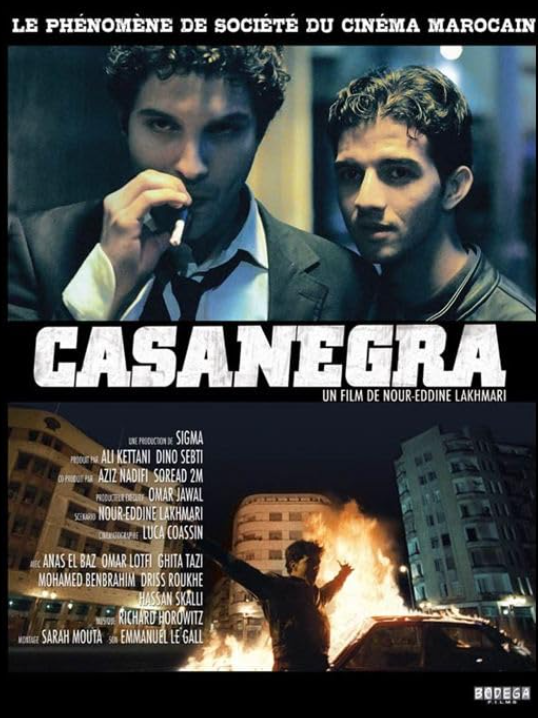
The poster for Casanegra teases its gritty vibe: two young hustlers, Karim and Adil, front and center against the glowing night streets of Casablanca. It’s immediately clear this isn’t the Casablanca of Hollywood myth, there are no gin joints or nostalgic songs here, only the smoke, sweat, and neon of real city life.
Casanegra plunges you into the back-alleys and bustling districts of Casablanca, painting the city in gritty, intimate detail. For those of us who grew up there, it’s almost surreal. I recognized the old downtown art deco buildings and chaotic street corners that I’ve passed a thousand times, now serving as the film’s evocative backdrop. The cinematography makes masterful use of the city’s atmosphere: most scenes unfold after dark, the streets bathed in shadow and neon glow. This isn’t just for style; the director deliberately keeps much of the film at night to mirror the characters’ internal anxieties. The result is almost noir-like – Casablanca becomes a character itself, by turns beautiful and menacing. One moment you get a sweeping view of familiar avenues, and the next you’re peering into a dingy cafe lit by a single weak bulb. I could practically smell the smoke and street food, hear the distant car horns and chatter. The city I know and love is captured in all its rough-edged glory. What struck me most is how honest the film is about Casablanca’s underbelly. It doesn’t shy away from what’s really there: poverty, crime, hustlers on every corner, and youth growing up with broken dreams.
This unflinching realism was shocking to some – Casanegra was even criticized for its use of raw, vulgar street language, with some calling it uncomfortably crude. (Indeed, a few of my own acquaintances admitted they avoided watching the movie with their family because “I heard it’s very vulgar.”) But to me, that Darija slang and swearing was oddly thrilling to hear on film, because it’s exactly how people talk in the real Casablanca. The film was groundbreaking in that sense, it’s been noted as one of the first Moroccan movies released without heavy censorship, openly exposing parts of society that local cinema usually tiptoed around.
Yes, the characters curse, fight, and struggle in ways that might make some viewers uncomfortable, but it’s genuine. By not sanitizing their speech or actions, Casanegra earns its authenticity. There are moments of dark humor sprinkled in as well, just as in real life.
This balance between harsh reality and humor keeps the film from being a depressing slog; instead, it feels like life. As a viewer from Casablanca, I found myself laughing at inside jokes one minute and somber the next, utterly absorbed. In the end, the film’s portrait of the city comes off as almost affectionate despite all the grit, as one reviewer observed, Casablanca here is “harsh, but it’s home… ugly, but beautiful”
The frustration and love are intertwined. It’s a bleak portrait folded into what is basically an homage to the city itself, and that paradox resonates deeply with me. Casablanca is harsh, chaotic, and tough to love at times, but it’s my home, and Casanegra gets that.
At the heart of Casanegra is the story of two childhood friends trying to find their way on Casablanca’s unforgiving streets. Karim (played by Anas El Baz) and Adil (Omar Lotfi) are twenty-somethings in the city’s underclass, hustling through petty scams and odd jobs to survive. They spend their days running small-time schemes, selling cigarettes or doing shady favors, and their nights loitering under city lights, swapping banter and half-serious life plans. Despite their tough circumstances, the banter between them is filled with an infectious, gallows humor and camaraderie. I found myself grinning at their sarcastic jabs and the authentic Casaoui (Casablanca-style) jokes they share; it reminded me of guys I knew in my old neighborhood, always ready with witty one-liners even when things are falling apart. Each friend carries a dream that keeps them going. Karim, the more sentimental of the two, nurtures a secret crush on a wealthy girl named Nabila. He’s the romantic, daydreaming about a love story that might bridge the social divide. Adil, more hot-headed and desperate, fixates on escaping abroad; he’s convinced that buying a visa to Sweden will solve all his problems, and he gazes at a postcard of Stockholm like it’s a portal to a better life. These dreams are their beacons of hope in an otherwise dim reality. As the film unfolds, we see how both men try to push their fate: Karim awkwardly pursues his upper-class love interest from afar, and Adil gets entangled in a risky scheme to get that fake visa. I won’t spoil specifics, but it’s no Disney fairy tale, just the harsh reality of Casablanca, and it has a way of undercutting their grand plans at every turn. One by one, life teaches them brutal lessons, and they begin to realize that their dreams might be painfully unattainable, the fragile hopes they cling to crumbling away.
Watching this hit me hard; as someone who has harbored my own big dreams in a tough environment, I felt their disappointments in my gut. There’s a moment where Karim’s romantic fantasy collides with cold reality, and the hurt in his eyes… I had to blink back a tear because I know that feeling. Adil’s storyline, too, builds to a point where you can almost physically feel his frustration, that mix of anger and sadness when you’re stuck in a place you’re dying to escape. Through it all, the friendship between Karim and Adil is the emotional anchor of the film. They bicker, they laugh, they have each other’s backs when it counts. There’s a beautiful, albeit rough-edged, tenderness in their relationship, a genuine brotherhood forged on those streets.
Even as their individual dreams falter, their bond endures the chaos, providing moments of warmth in the dark. One of my favorite scenes is just the two of them sitting on a rooftop above the city at night, sharing a cigarette and musing about “making it” one day. It’s a quiet moment amid the turmoil that really humanizes them.
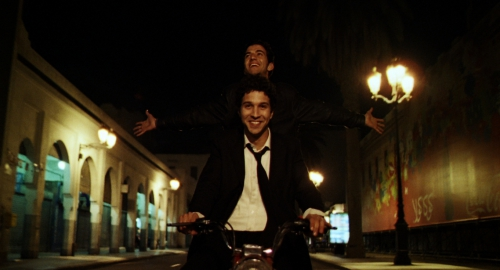
The performances by Anas El Baz and Omar Lotfi feel incredibly authentic; you forget you’re watching actors, so natural is their chemistry. They convey the swagger and vulnerability of Casablanca’s youth with equal conviction, and their emotional beats, from mischievous grins to angry outbursts all ring true. (It’s no surprise the two actors actually jointly won Best Actor awards for their roles in this film (a well-deserved recognition of their powerful portrayals.) Despite the film’s dark tone, there are flashes of humor and humanity that shine, often thanks to colorful side characters. Perhaps the most memorable is a local gangster kingpin who employs the guys for a job. This man is genuinely terrifying (kudos to Aziz Dadas for this role!) the kind of villain who casually threatens to drill holes in people’s knees, yet he has one soft spot: an adorably tiny pet dog that he loves more than anything. The absurd image of this hardened criminal cooing over his little dog had me laughing out loud in disbelief. And when things go south for him (in a spectacularly chaotic climax I won’t reveal), he ends up distraught, wailing the dog’s name (“Nicooooo!”) into the night, a moment that is as tragic as it is darkly comic. It’s scenes like this that exemplify Casanegra’s unique tone. The film isn’t afraid to be hilarious and heartbreaking in the same breath, oscillating between violence and tenderness, dread and absurdity. As one reviewer aptly put it, despite all the grim events, the movie is ultimately “hilarious and redeeming.”
I found myself cackling at a sudden joke or absurd situation, then moments later tensing up as the characters face danger. That emotional whiplash felt true to the spirit of Casablanca – a city where you often have to laugh through your hardships.
By the time the credits rolled, I was emotionally spent but oddly uplifted. Casanegra took me on a journey through the soul of Casablanca, my soul, in some ways – warts and all. It’s a film that left me sitting quietly for a while after, thinking about the streets I grew up on and the people who hustle through their days there. I felt proud, too, because Casanegra is more than just a movie; it’s a cultural milestone. It struck a chord with many others as well, becoming a phenomenon in Moroccan cinema, and itt even broke box-office records in Morocco and snagged multiple international awards. (Imagine, this gritty little street tale from Casa winning 21 international awards and being chosen as Morocco’s official submission to the Oscars!)
That’s how much it resonated. But beyond the accolades and numbers, for me it’s personal. I carry scenes from this film in my heart: Adil screaming into the void of the city, Karim walking away under the neon lights, two friends joking on a rooftop as if the night will never end. Casanegra captures the essence of a place and time that I know intimately, and does it with such raw honesty that it leaves me both shaken and seen. It’s the kind of film that makes you laugh while breaking your heart, and long after it’s over, it lingers like the memory of a wild night in the city. In the end, Casanegra is a love letter to a Casablanca that tourists rarely see and a story of friendship that anyone can relate to. It’s harsh, it’s unflinching, but it’s also bursting with life and emotion. Every time I rewatch it, I’m reminded why I fell in love with cinema, and why, despite everything, I’ll always love my city. Casanegra made me feel proud of Casablanca in a strange way, proud that our messy, beautiful reality could be turned into art that speaks to the world. If you ever want to experience Casablanca beyond the postcard veneer, to feel its pulse, its grit, and its heart, Casanegra is waiting to take you there. It took me home. And I’m grateful for every uncompromising minute of it.
What about you, reader? Have you seen Casanegra? What did you think of its portrayal of Casablanca? Did any scenes or characters stick with you long after the credits rolled? I’d love to hear your thoughts in the comments. 🙂
As of now, Casanegra might be a bit tricky to find on mainstream platforms, but keep an eye out for it on indie film sites, Moroccan cultural screenings, or digital rentals. If you find a good link, share it. Let’s help more people discover this hidden gem.
Leave a Reply