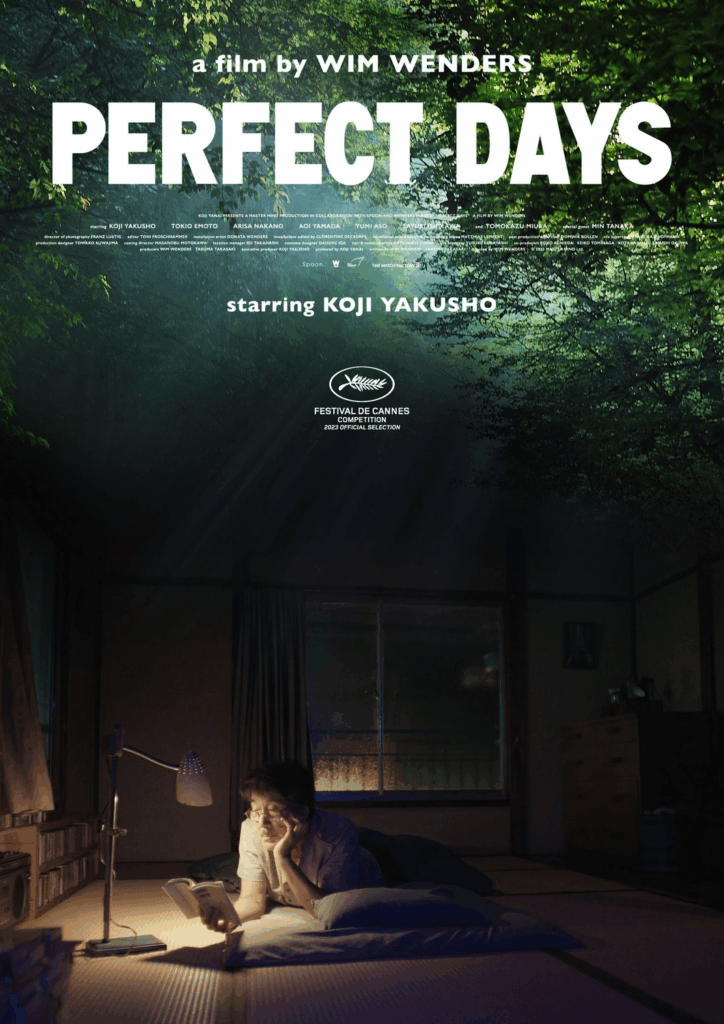
Warning: contains mild spoilers, quiet feelings, and unexpected tears over trees.
Let me start by saying: Perfect Days isn’t loud. It’s not flashy. It’s not trying to shock you or make some big dramatic statement. It’s the cinematic equivalent of a deep breath, and honestly, I didn’t know how much I needed that until I watched it.
Directed by Wim Wenders (yes, the same guy behind Paris, Texas), this Japanese film follows Hirayama, a middle-aged man who cleans public toilets in Tokyo. That’s it. That’s the plot. And somehow? It’s magical.
I know what you’re thinking: “A movie about toilets?” But hear me out. This film is a love letter to the little things: soft light filtering through trees, cassette tapes playing Lou Reed or Patti Smith, and the quiet ritual of a perfectly made bento.
Hirayama’s life is simple, but never empty. There’s something deeply comforting about watching someone live with intention, kindness, and quiet joy.
Koji Yakusho (who won Best Actor at Cannes, by the way, and deservedly so) gives a performance that says a thousand things without speaking. His face holds so much grief, gratitude, nostalgia, and somehow you feel it all just watching him sip his canned coffee or smile at a stranger. I found myself getting emotional over things I didn’t even realize I cared about, like the way the sun hits the leaves or the sound of a broom on pavement. Who am I??
What I loved most is how the film never rushes you. It doesn’t push a plot in your face or demand your constant attention. Instead, it gently taps you on the shoulder and says, hey, slow down… look. Look at the way sunlight dances on a curtain. Listen to the sound of wind through the trees. Watch someone fold their clothes with care or water a plant like it’s the most important thing in the world. In a culture that glorifies hustle, noise, and constant productivity, Perfect Days feels almost radical in its stillness. It asks you to stop scrolling, stop racing, and just be. And that felt revolutionary.
There’s something incredibly moving about a story that reminds you how sacred the everyday can be. That a simple routine like waking up, cleaning, eating, reading, and sleeping can be full of grace and meaning when done with presence. Hirayama doesn’t talk much, but his quiet acts of kindness, his eye for beauty, and the way he holds space for joy and sadness alike feel like poetry in motion. This isn’t just a movie about toilets and trees. It is about finding beauty in the mundane, choosing kindness even when no one is watching, and slowly, patiently making peace with the past through the rhythm of a life well lived.
If you’re craving explosions or plot twists, this isn’t the one. But if you want something that feels like a warm cup of tea for your tired soul? Please watch this. It’s tender, meditative, and surprisingly moving.
My rating? 8/10. Will be romanticizing my own life for the foreseeable future.
Did this film stir something in you too? I’d love to know what stayed with you after the credits rolled.
Leave a Reply